May 14, 2018

Trip to Crestone in 2018

If we do everything with a noble intention, then everything we do is noble. Ask yourself three questions: Where are you? Where is really home? What are you doing here?
                                                                          -----
Mu Deng
 

      Recently, we visited Crestone, a “spiritual vortex” in Colorado, with a group of Chan practitioners from China. How incredible it was to be exposed to such concentrated wisdom in a small mountain town with a population of less than 150! Being immersed in the true harmony among different world religions, spiritual practices, and conscious organizations was truly a treasurable rare experience! How profound it was to receive Chinese Chan teaching while absorbing teachings from all the wisdom traditions that we encountered! May such a vibrant and open-hearted spiritual community continue to evolve to its full potential for generations to come.

The Crestone Prophecy
Crestone is situated in the northern part of the San Luis Valley, a sacred land of natural harmony, where no colonial nor tribal conflicts have shed blood in the past. Native Americans called it the Bloodless Valley, which is also a “cultural crossroads” and “where the light comes into the world.” It drew many prehistoric Native American groups to come, primarily for healing ceremonies, vision questing, hunting, collection of food and medicines, and rights of passage for Native American youth.
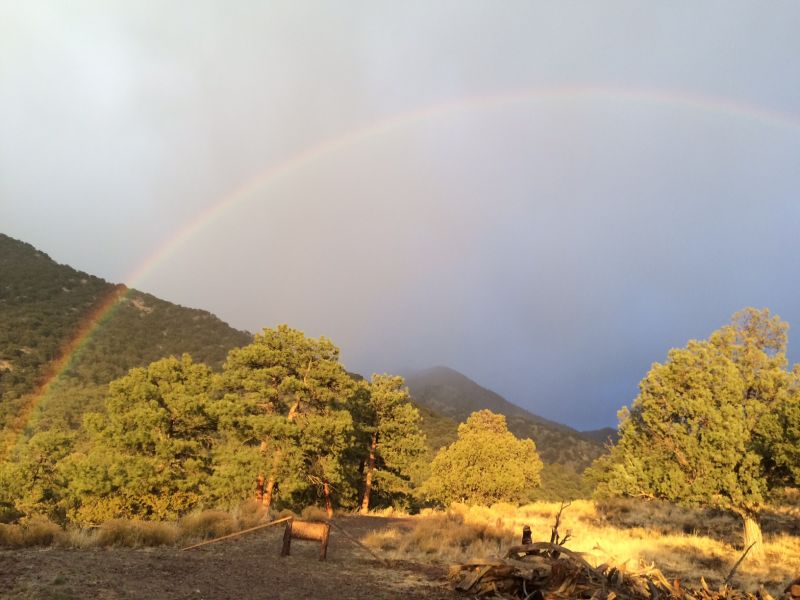


In the 1960’s, Glen Anderson, a local mystic, whom some called the modern day Prophet, predicted that a foreigner from overseas would come and create a new high vibrational interfaith community—a refuge for all the world spiritual traditions with direct lineages; several off-the-grid communities would be created with an emphasis on the highest level of spiritual and cultural development; the main purpose of creating such community would be to bring forth a new civilization of humanity that is in harmony with themselves, each other, and Nature; and thousands of children would seek refuge there.

In 1977, Maurice Strong, the founding Executive Director of the UN Environmental Programme (UNEP), and his Denmark-born wife, Hanne Strong, purchased a large tract of land in the Crestone area. In October 1978, when Hanne Strong arrived and settled in their ranch, Glen Anderson knocked at her door and said, “I have been waiting for you to arrive.” He revealed to Hanne that she would be the one who would manifest the vision of bringing different world wisdom traditions and religions to Crestone to “help bring forth a new civilization of evolved human beings,” and Crestone would be known to the world for its interfaith community and its commitment to education, environmental protection, and spiritual pursuits. Shortly after meeting Glen, Hanne retreated to the mountains for a four-day-and-four-night vision quest and knew in her heart that Crestone would become the “Refuge for World Truths.” Before she moved forward with this vision, Hanne consulted the indigenous elders of the Hopi Nation, whose roots in the San Luis Valley could date back to thousands of years ago, and received the affirmation from the elders.

The Strongs decided to donate some of their land to world religious and spiritual lineages that agreed to establish centers in Crestone. To coordinate the program, they founded the Manitou Foundation. Today’s Crestone harbors an amazing array of spiritual sites: ashrams, monasteries, temples, retreat centers, stupas, labyrinths, medicine wheels, sweat lodges, and other sacred landmarks. There’s even a ziggurat, a structure modeled after the temples of ancient Babylon. Over the last four decades, many Native American medicine people have returned to this land for ceremonies and recognized the valley as a place of high spiritual significance and potency for transformation.

Below I'd introduce a few noble souls and centers that we visited in Crestone.

The Strongs--The Founding Family
In 2013, late Maurice Strong spoke at the Asia Education Forum General Conference and Ecological Education and Sustainable Development Forum in Chengdu, China, “We are the first generation ever to have the responsibility for our own future. What we do, or fail to do, will determine the future of life on Earth. This requires unprecedented levels of cooperation both within and amongst nations.” He also pointed out that “the healthiest and more sustainable natural ecological systems are those which maintain the highest degree of diversity and variety,” and it requires us to make fundamental changes in our educational economic system and “resist the temptation merely to patch up the existing system” that leads to its crisis.

As we gathered around Ms. Hanne Strong at her home, her deep longing for having indigenous Grandmas to come to the land to heal wounds and share wisdom, her passion for bringing ecological awareness to more and more young people, and her concerns for the future of humanity moved us to tears, and yet, her cheerful nature and laughter brightened up our spirit and inspired us to work together toward an awakened future.

James O’Dea--The Conscious Activist
James O’Dea is a former President of the Institute of Noetic Sciences, Washington office director of Amnesty International and CEO of the Seva Foundation. Among many other noble services that he offered to the world, he has taught peace-building to students in 30 countries and conducted frontline social healing dialogues around the world.

In his Crestone home, James first brought our awareness to the four levels of Heart: Thinking Heart, Feeling Heart, Inspired Heart, and Illuminated Heart. He then shared with us the story that set the tone of the bittersweetness of his life. He was conceived several days before his 11-year-old sister died, and his mother found out that she was pregnant with a new baby while losing a child. After witnessing tremendous unspeakably cruel human-caused sufferings, the question that he had been waiting to be asked all his life until that point was delivered to him on a seemingly aimless outing in Bolinas, a hidden coast town north of San Francisco Bay, “How do we integrate spirituality with activism?” His lifelong search on this topic is captured in his book, The Conscious Activist, where activism meets mysticism.

At the end, James shared his soul-awakening prayer, and we repeated after him in both English and Mandarin Chinese:
Soul Awakening, Heart Opening, Light Shining, Love Flowing, Wound Dissolving, Peace Radiating.

As the high souls from the East and the West spoke the shared vision, the room was filled with timeless stillness....


William Howell--Camino de Crestone
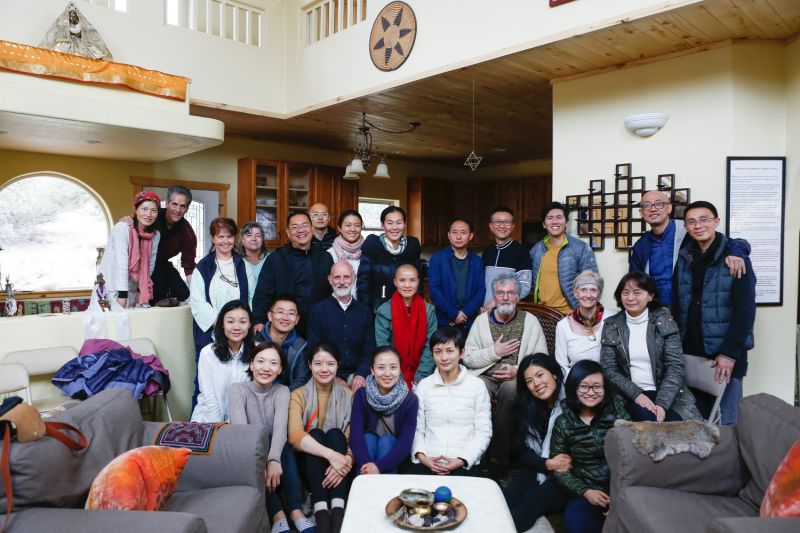
William Howell, bedsides his role as our spiritual tour guide in Crestone, is a poet and author, retreat master, and meditation teacher, who immersed himself in world's great wisdom traditions for 40+ years. Inspired by Camino de Santiago that he and his wife, Brahmi, walked, they founded Camino de Crestone pilgrimage, which is offered in the spirit of religious unity and diversity. This year, William has handed over the torch of Camino de Crestone to his successors, as he and Brahmi are ready for their next soul calling. A while ago, they have also let go of the form of Sanctuary House that they founded 26 years ago, but kept their heart open for whomever hears the call to find them. The tour he led in Crestone was of profound quality due to his deep connections in the Crestone spiritual community.

During our tour, William was often seen standing outside to hold the door for us, and always the last one to go to the buffet line at meal times. He truly cared about each of us and took all the time to explain to us the history and the stories of Crestone. When he looked at you, he took you in completely, making you feel that you were the only one that mattered to him at that moment in the entire world. Whenever he was moved by Truth, tears would instantly fill up his eyes. To me, he is someone who has long ago given himself to the Service on the Path of Awakening.


He seemed ageless. In his 70s, he is still a playful child at heart. While approaching the Dome at Crestone Mountain Zen Center at dusk, he was crouching, running, hiding.... as if the Dome were a fort occupied by an opposing force. We all laughed hard and mimicked him. Inside the Dome, as suggested by a sound healer among us, we formed a spontaneous humming/singing circle, and William was the first to contribute to our collective chorus with his clear and deep voice.

Haidakhandi Universal Ashram and Ramloti
During our short stay in Crestone, we stayed and ate most of our meals at Haidakhandi Universal Ashram (HUA)--a Babaji ashram. It is an off-the-grid center, solar-powered, with their own water system.

Babaji became known to the West through Paramahansa Yogananda's book--Autobiography of a Yogi, from reading which our gracious host Ramloti instantly became a devotee of Babaji in the early 1980s. Disregarding all the obstacles in her life, Ramloti went to visit Babaji in India several times before He left His body in 1984.

During one dinner at the Ashram, Ramloti shared with us the story of visiting Babaji with her two young sons. As she and her sons were near Babaji's ashram, Babaji sent a person to greet them. How did Babaji know they were coming! Ramloti wondered. When they arrived, Babaji handed her and her sons each one cup of Indian tea that he made. Ramloti was convinced that Babaji must have mistaken her for someone important. :) In the past, she had worked hard to impress people and to cover up her fear inside. Whenever someone complimented her, she would tell herself, if they knew who she really was, they would not think highly of her, because she was not good inside. It was not until much later in her life did she experience that everyone is worthy of divine love and she is loved by the Divine Mother at every moment.

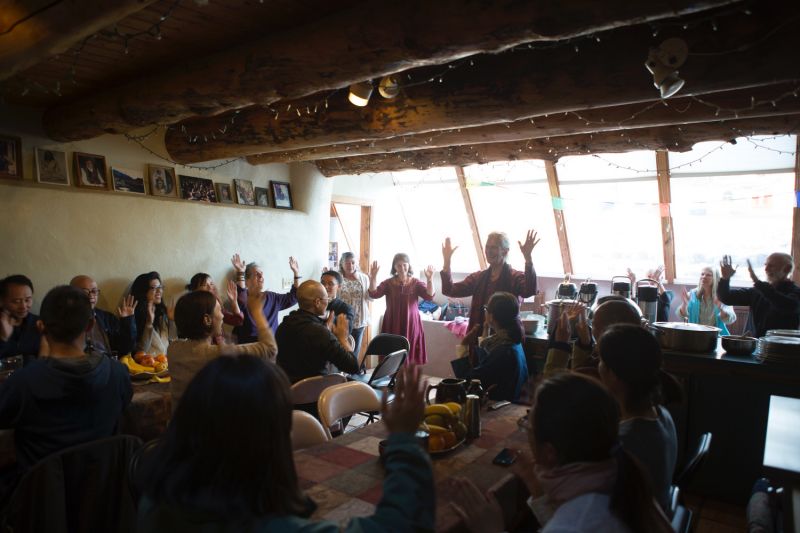
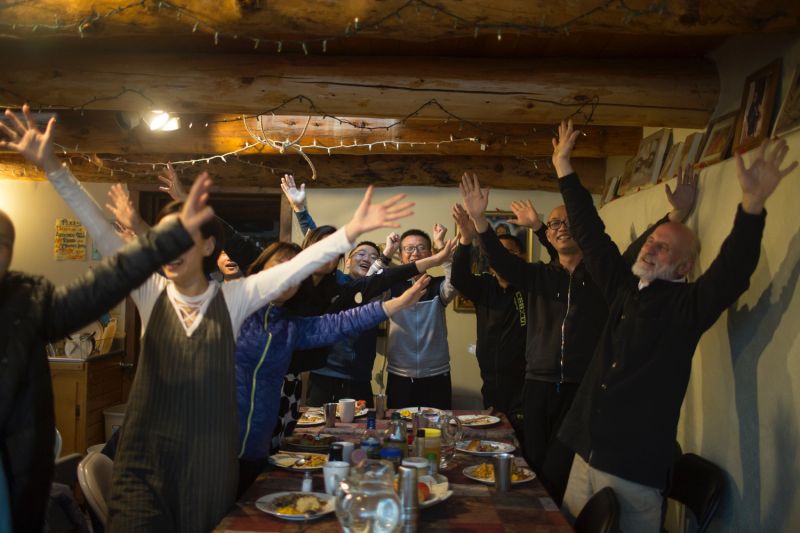
In the Ashram temple, the residents change the outfit for the Divine Mother statue every morning, and the practitioners and visitors arise early for spiritual practices, meditation, and Aarati (a sung worship service). They respond to all deities' names with "Jai!" At meal time, when Ramloti gave meal offering to all the deities, we all cheerfully raised our hands and responded "Jai!"

Other Visited Spiritual Centers, Organizations, and Artists
The Spiritual Life Institute is a Roman Catholic community with roots in the Carmelite contemplative tradition. “Be still and know that I am God” They aspire to create a vital environment characterized by "solitude, simplicity and beauty." The retreat center, nicely tucked in Nature, is open to people of all faiths and all walks of life, who need a solitary place to reconnect with their own roots in God. Father Eric has lived there for 35 years and worked as a carpenter and plumber to help build the center. Every day, he drinks tea, prays, works, and enjoys nature.
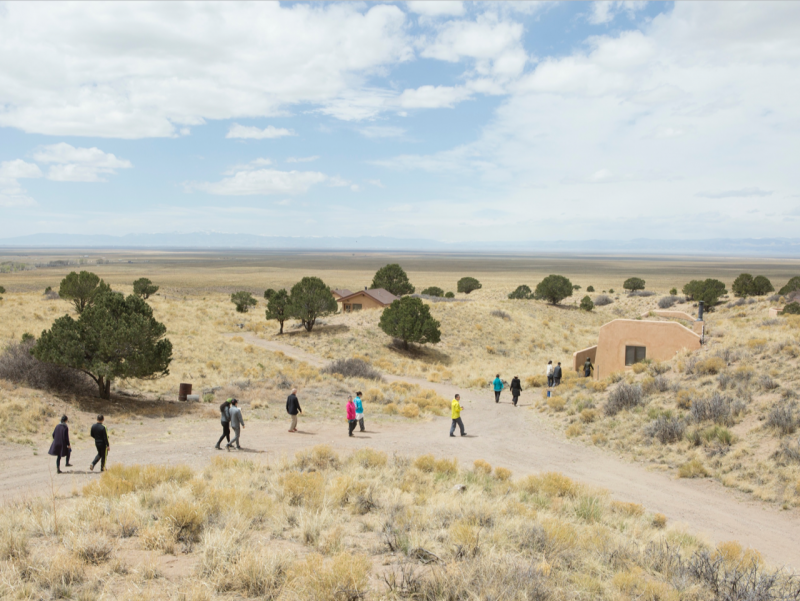


Shumei International Institute is a non-profit organization originated in Japan. The founder, Mokichi Okada, taught that a world free of sickness, poverty, and discord is within everyone’s reach through the spiritual healing of Jyorei, the practice of Natural Agriculture, and the appreciation of Art and Beauty. Jyorei, which means “purification of the spirit,” is a simple yet profound healing art. Our host Matthew Crowley shared the two most important teachings that he learned from Shumei: "Nature teaches us everything." "If you want to be happy, make others happy." Shumei transformed him from a competitive businessman into a spiritual practitioner who is willing to become a channel that transmits light to others.

Chamma Ling Retreat Center preserves ancient Bön Practices, Tibet’s oldest spiritual tradition, to restore and to heal the world. Ms. Hanne Strong recommended the soul retrieval retreat offered at this center.

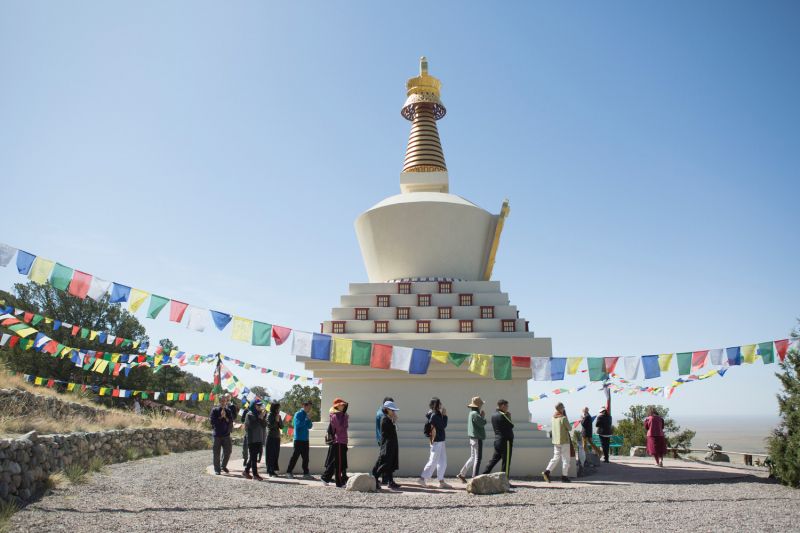
We chanted and circled around the KTTG Stupa. Karma Thegsum Tashi Gomang (KTTG) was founded by His Holiness the XVI Gyalwa Karmapa, head of the Kagyu order of Tibetan Buddhism. Stupa is an architectural rendering of the Buddhist path, the stages and aspects of enlightenment. If seen from above, this white Stupa with golden spire on top looks like the eye of this valley. What made this Stupa even more special is that 100,000 miniature stupas made by volunteers were placed inside. Within each miniature stupa is a roll of prayers, and mantras. The 100,000 stupas were all blessed and consecrated by visiting lamas before being placed inside. Although these 100,000 miniature stupas and the prayers inside were invisible to our eyes of flesh from the outside, the noble intention and high consciousness radiate out from the inside and reach the realms far and beyond.


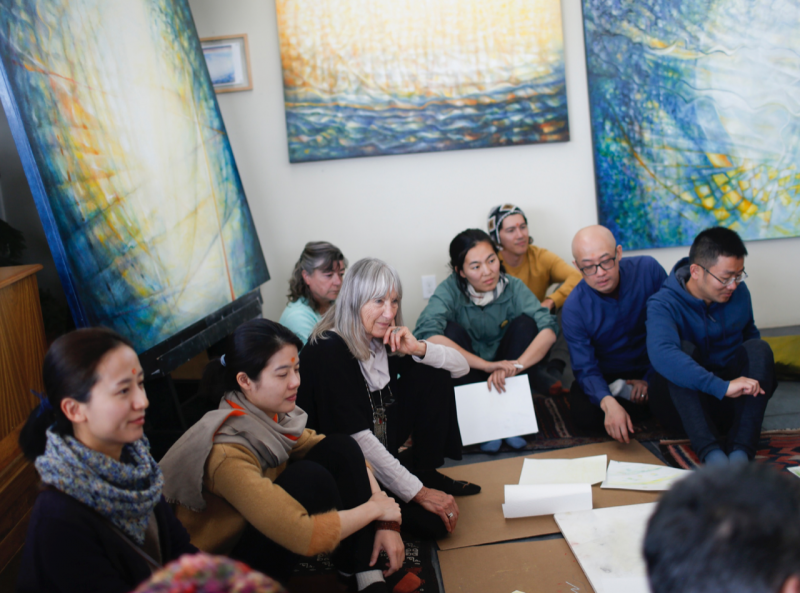
We meditated in Vajra Vidya Retreat Center and were completely charmed by the lighthearted and cheerful teacher Venerable Khenpo Lobzang Tenzin. We tried our conscious drawing after meeting Marika Popovits, who has been expressing realities through paintings within the realms of Consciousness since 1970s. We were mesmerized by Singne Ramstrom's forceful ancient dance at her home studio, where we also had Chinese Chan tea ceremony with the Crestone spiritual community. I missed the meeting with John Milton, one of the founding fathers of the modern environmental movement, a pioneering ecologist, spiritual teacher, vision quest leader and shaman, who founded Way of Nature. I found his twelve guiding principles of natural liberation very helpful tools for practices.


The Cross pollination Among Centers
Ramloti borrowed chopsticks and hot water containers from Shumei Center in order to host us. At the Ashram store, there were James O'Dea's books on display. Marika said she was inspired by one of James O'Dea's poems to paint and James was inspired by her painting to write a poem. Hanne took the vision quest with John Milton after meeting the Prophet Glen Anderson, and John Milton now serves on the board of Manitou Institute. Shumei hosts Crestone's community gathering at their outdoor amphitheater. How much pure joy we experienced when we gave each other Sufi kisses! And William connects with everyone, and everyone seems to connect with everyone else! :) It's a true harmonious spiritual community in Crestone.
 

As Ms. Hanne Strong said to us, "Nothing will happen in Crestone until original people return. When in great harmony, great things will happen. Our soul and life depend on each other. Anyone who can speak for the land...ask what the land wants. No matter what happens...the truest purpose of humanity will be preserved."

January 12, 2018

Fritjof Capra and His Work

[Taking Capra Course was one of the most mind-opening learning experiences for me in 2017. It's an online course taught by Fritjof Capra based on his book--The Systems View of Life, which will certainly inspire more people to apply systems thinking in their organizations, corporations, and governments, and in all aspects of our lives. It can help unify series of social movements, such as the environmental and ecological movement, the feminine movement, the peace (non-violent) movement, the racial justice movement, and the holistic health movement, etc.

Also through Capra's teaching, I understood conceptually how ServiceSapce ecosystem has been able to grow through relationships and networks and why ServiceSpace continuously holds space and circles for emergent questions and projects. Later last year, Fritjof Capra generously accepted our invitation to be on our Awakin Call in March this year. Deep gratitude for his generosity and humility, his love for teaching, and his gift in learning through dialogues. You can read more about his journey and his work in the following passage.]


Fritjof Capra, Ph.D., Austrian-born American physicist and systems theorist, spoke on “Voices” in London in 1984, “For the modern physicist, the material world is no longer a mechanic system made of separate objects, but rather appears as a complex web of relationships that include the human observer and his or her consciousness. There is no material substance in the subatomic world; it’s a world of dynamic patterns, continually changing into one another.” He regarded the paradigm shift in modern physics as a precursor to the cultural transformation from a mechanistic worldview to an ecological vision of reality, and systems theory as a scientific framework for the new paradigm.

Capra is a scientist, educator, activist, and author of many international bestsellers. Over the past three decades, he has been engaged in a systematic exploration of how other sciences and society are ushering in a similar shift in worldview, or paradigms, leading to a new understanding of the social implications of this cultural transformation.

He first became popularly known for his book published in 1975, The Tao of Physics, which explored the parallels between modern physics and Eastern mysticism, and how modern physics was changing our mechanistic worldview to a holistic and ecological worldview. Four decades later, The Tao of Physics is still in print in more than 40 editions worldwide.

Inspired at age 18 by the book Physics and Philosophy by Werner Heisenberg, one of the founders of quantum physics, Capra realized early on that quantum physics implied a whole new worldview. After receiving his Ph.D. in theoretical physics from the University of Vienna in 1966, Capra spent 20 years conducting research in high energy physics at different universities in Europe and the U.S. and also taught at some of the universities. In 1968, after two years in Paris, Capra came to work at the University of California in Santa Cruz, where he encountered the counter-culture hippie movement and became interested in meditation and Eastern philosophy. Almost immediately, he saw the connection between the ancient Eastern philosophy and modern physics.

One late summer afternoon, when Capra sat on a Californian beach watching the waves and feeling his breathing, he suddenly became aware of his entire surroundings, the sand, rocks, water, and air, as being engaged in a gigantic cosmic dance. What he learned in high-energy physics through graphs, diagrams, and mathematical theories suddenly came to life, as he “saw” and “heard” the Dance of Shiva. Being trained in detailed analytical thinking, Capra was so overwhelmed by this transformative experiential insight that he burst into tears.

In 1971, when he worked at the Imperial College in London, Capra made a photomontage of particle tracks in bubble chamber with the Dancing Shiva. When he showed it to an Indian physicist in his office, his Indian colleague, who had to remove himself from his Indian tradition in order to study physics, cried at the sight of this profound unifying image. After publishing three articles addressing the connections between Eastern philosophy and modern physics, Capra began to write his first book The Tao of Physics.

Capra’s later books include: The Turning Point (1982), Uncommon Wisdom (1988), The Web of Life (1996), The Hidden Connections (2002), The Science of Leonardo (2007), and Learning from Leonardo (2013). The movie Mindwalk (1990) is loosely based on his book, The Turning Point. All his books connect conceptual changes in science with broader changes in worldview and values in society. In 1991, Capra co-authored Belonging to the Universe with Brother David (David Steindl-Rast), a highly regarded Benedictine monk, to explore parallels between new paradigm thinking in science and in theology, and how these new paradigms offer remarkably compatible views about the universe.

As a young child, Capra had direct contact with nature and learned to farm. Born in 1939 in Vienna, Capra lived on his grandmother’s farm for 10 years when his whole family took refuge in the countryside after World War II. By necessity, his extended family and war refugees found a way to live on the farm self-sufficiently as a community. They grew vegetables, baked bread, and raised animals. He saw women taking sunflower seeds off the sunflowers to make sunflower oil under the lamp light in the evening. Everything was recycled and reused on the farm.

Those early years planted in Capra the seeds of ecological awareness, sense of community, and sustainability. Today, over 60 years later, he can still draw a detailed map of the farm after it was long gone. Knowing deeply the significance of taking children out to nature or school gardens, in 1995, Capra co-founded the Berkeley-based Center for Ecoliteracy, which is dedicated to advancing ecology and systems thinking in primary and secondary education. He co-authored EcoManagement, and Green Politics, etc.

Over the past thirty-five years, Capra has frequently given management seminars to top executives in Europe, North and South America, and Japan. Currently, Capra serves on the faculty of the Amana-Key executive education program in São Paulo, Brazil, and is a fellow at Schumacher College, an international center for ecological studies in the UK. He also serves on the council of the Earth Charter Initiative.

His recent book, The Systems View of Life (2014), which he co-authored with Pier Luigi Luisi, Professor of Biology at the University of Rome, explores the new systemic conception of life at the forefront of science and its application in economics, management, politics, design, medicine, and law. It presents a grand new synthesis of Capra’s work—integrating the biological, cognitive, social, and ecological dimensions of life into one unified vision. Several critics have suggested that The Systems View of Life is destined to become another classic.


Capra is now in transition from active research and writing to teaching and sharing knowledge. He no longer gives workshops or seminars, and has reduced his travels and lectures to concentrate fully on Capra Course, his new online course, based on the textbook The Systems View of Life. During the 12 online lectures, participants from around the world join the discussion on systems thinking with Capra. This course is the realization of a dream that Capra had for many years. It will provide the participants the conceptual tools to understand the nature of our systemic problems and to recognize the systemic solutions that are being developed by individuals and organizations around the world. He hopes that Capra Course will serve as a model for similar multidisciplinary courses at universities, colleges, and other institutions of learning.

The alumni of the Capra Course stay connected online and in person around the world, sharing ideas and collaborating on emergent social projects, such as BARRIO SOLAR, a new organization formed in 2017 through the Capra Course alumni network in response to the devastation in Puerto Rico after Hurricane Maria.

Capra holds deep gratitude for his mother, a poet, who brought literature into his life, and his father, a lawyer by trade and a philosopher at heart, who ushered him to the world of philosophy at an early age.

Scientists, therefore, are responsible for their research not only intellectually but also morally. This responsibility has become an important issue in many of today's sciences, but especially so in physics, in which the results of quantum mechanics and relativity theory have opened up two very different paths for physicists to pursue. They may lead us—to put it in extreme terms—to the Buddha or to the Bomb, and it is up to each of us to decide which path to take.” ------- Fritjof Capra, from The Turning Point

Sources and Other Related Articles:

November 22, 2017

My Journey of Performing My Life Stories on Stage


Being a Chinese peasant’s daughter was my biggest shame growing up in China. In the '80s and '90s, peasants made up 80% of the population in China. They had the lowest social ranks, not only excluded from enjoying any social benefits, but also had to pay heavy agricultural taxes. When my family went to town, I could feel that we were looked down upon by city people. From a young age, I struggled with this discrimination against peasants and only wished that I were born to factory workers’ family. I saw my mother crying many times for not being respected. She said that she would do anything to support my brother and me going to school, so we would not grow up to be peasants like her.
 

Thirteen years ago, I crossed the Pacific Ocean to pursue my American “dream” of building a new social status for myself and my family. But five years later, that “dream” changed. I felt lost in climbing the social ladder in Corporate America. The “dream” was turned into an open-ended search, which still keeps unfolding. That was when I first started telling my stories on stage as a personal healing process.

 The Marsh, San Francisco (2012)

The Open Book, Grass Valley (2017)

Two years ago, after six years of writing and performing in various venues in the Bay Area, I grew tired of the same old story that I kept telling. Recounting what happened in the past didn’t lead me onto any new path that was meaningful to me. Meanwhile, as I met more and more people who devoted their lives to serving meaningful causes in their communities or in the world, I felt ashamed and guilty of focusing on myself. Inside, I felt deeply lost again. Thus, I stopped performing.

After a two-year hiatus, life somehow led me back to my own story. It is a story that will wait for me to finish if I don’t. After acting in the play Chinglish, produced by Community Asian Theatre of the Sierra (CATS) last year, I was invited by Jeannie Wood, the Executive Director of CATS, to share my full-length story at a book store in Grass Valley. I accepted it. I was thankful that Jeannie valued my story, but also anxious and perplexed about my new relationship with my own story, with my mother and my family, with my ongoing search of the meaning of life, and with China.

My mother is a generous soul who always serves, serving her own family and also neighbors and friends, while I have been very much focused on myself, studying, working, and finding the best way to live my life. It has always been my needs that come first. But as I grow older, I want to be more like my mother. My mother continues to be such a resilient and adaptable life force in my life, and I realized that there is so much I can learn from my illiterate mother, who is open to new things and ready to leap forward with relentless courage. 

Last year, I went back to China and lived there for five months. My decision to spend more time with my parents in China was not out of filial obligation, but a longing in my heart to be physically closer to my parents and to give thanks to them on a day-to-day basis for what they have done for me. In other words, I wanted to cultivate kindness within myself at the root level. While cultivating kindness within, I began to see kindness in many others in China. Instead of being cynical about the ugly side of China, I began to look at modern China with fresh eyes.

Filial piety is a virtue of respect for one's parents, elders, and ancestors. During the trip to China, I learned that there are four levels of filial piety: First, taking care of parents’ body (offer parents food, clothing and other necessities); second, taking care of parents’ heart (make them happy and not worried); third, helping realize parents’ dreams and purpose in life; fourth, opening parents’ minds and hearts for wisdom.

On one hand, I am thankful that I learned what true filial respect means before it is too late; on the other hand, I realized that becoming a filial daughter would be a lifelong practice.

I want to
integrate and reconcile the two cultures across the Pacific within me, without imposing one on the other. It’s a lifelong dance between the ancient and the modern, the East and the West, and between the seeking of personal liberation and family and social responsibilities.

I often ask myself: What is my passion in this life? What is my service to this world? These questions are still alive in me as my life continues to unfold. But it's clear to me that I want to live a life with integrity, not running away from my own shadows. I want to cultivate a deep sense of inner peace that gives me clarity and strength to go on each day. Every day is a potential new beginning. If I can find a way to shine light into all the shadows and struggles in me, I'd like to use that same light to light up the world. That could be my service to the world, I think. As the Zen Master
Dōgen Zenji put it, "To study the Way is to study the self. To study the self is to forget the self. To forget the self is to be enlightened by all things." Hope delving into my personal story could be my way of being liberated from it and then go beyond together with many others.

Upcoming performance at The Marsh Rising on February 7, 2018, Wednesday, 7:30pm.

October 5, 2017

Reading The Story of The Other Wise Man

I picked up this little book, The Story of the Other Wise Man by Henry van Dyke, at the Bay Area Storytelling Festival several years ago, and only read it recently. I'm deeply touched by the journey of this wise Persian man's seeking through services to humanity even when his services seemed to "distract" him from reaching the divine at times.

Who seeks for heaven alone to save his soul,
May keep the path, but will not reach the goal;
While he who walks in love may wander far,
Yet God will bring him where the blessed are.


The Story of the Other Wise Man
Some may know the story of Three Wise Men of the East, who traveled far to arrive in Bethlehem to meet the newborn Jesus, after seeing the sign from the stars. This story is about the “fourth” wise man named Artaban, who never made it to the physical presence of Jesus. He missed the appointed time to meet at the ancient Temple of the Seven Spheres where his three brethren waited for him for ten days before caravanning on their pilgrimage to Bethlehem.

Artaban sold everything he had for three treasures that he could gift to the newborn King of Israel--a sapphire, a ruby, and a pearl. He invited his friends to join him on this great pilgrimage too, but nobody believed in his vision. On the tenth day of his journey alone to the Temple with his tired horse, he was so close to his destiny when he saw on his path a dying man. Although he was painfully aware that helping that man could severely delay his meeting with his brethren, he couldn’t just walk away from that dying man and leave him for animals to devour. After restoring the man’s life, he traveled as fast as he could to the Temple, but only found a note from his companions who thought he might have given up on the pilgrimage.

In order to cross the desert alone, he had to sell the sapphire to buy camels and other supplies. Finally he arrived in Bethlehem, but three days too late to see the child, whose parents had fled to Egypt to avoid the massacre of infants in that area by King Herod.

In the middle of the massacre, Artaban used the ruby to save another child’s life before he traveled to Egypt and later many other countries. After 33 years, he was still a pilgrim, searching for Jesus. During those years, he found no one to worship but many to help. He fed the hungry, clothed the naked, healed the sick, and comforted the captive. It seemed almost as if he had forgotten his quest. He became old and weary. Sometimes he would wonder if his friend was right, “The darkness is equal to the light, and that the conflict between them will never be ended” With his last jewel, the pearl, resting in a secret place in his bosom, he arrived in Jerusalem again.

He learned that the King who had somehow led him for a lifetime of seeking over land and sea had arisen, and had been denied and cast out. There finally came a time for Artaban to offer the pearl for His ransom before he dies. As he followed the crowd to the execution site, a woman broke away from her tormentors and threw herself at his feet asking for saving her from being a slave. Artaban trembled. It was the old conflict in his soul. But how could he not help this woman? He took out the pearl and laid it in the hand of the slave.

Just then, sudden tremors ran through the earth and Artaban found himself lying helplessly beneath a fallen wall. As he was dying, a voice came to him:

"Verily I say unto thee, Inasmuch as thou hast done it unto one of the least of these my brethren, thou hast done it unto me."

A calm radiance brightening his pale face, Artaban found his King.

Self-Reflection
So often, as I hurry on my way to see a teacher who teaches compassion and love, I fail to see the elder who needs my help by the roadside. What am I really seeking then? There may be many ways climbing the sacred mountain; cultivating a pure heart and doing small acts of compassion at each divine or mundane moment seem to make the most sense. What is divine and what is mundane?

July 31, 2017

舍得 (To Gain is to Give) —The Story of A Chinese Mother (Translation)

   [I was greatly moved by this story written by a Chinese writer, ZHAO Haining. I felt inspired to translate it into English. It's a story of an illiterate peasant mother who helped and transformed many lives with small acts of kindness and her willingness to give when she lived. At her funeral, the line of people who attended was so long that it queued from one end of the village to the other. She reminds me of the essence of my own mother.]

Ten years after my father died, under my half begging and half forcing, my mother finally agreed to come to Zhengzhou to live with me—her youngest daughter. That year, she was 70, and I was 40. As age shrank her skinny one-and-half-meter-tall body by a few centimeters, she looked even smaller. But her face still looked bright and clean with few visible weathering marks, and her hair was not completely gray, some black hair remained resilient among the gray.


We borrowed a car to pick her up from her old home in a village. She had long ago cleaned up the old house where she had lived for many decades, and packed her belongings. Among her luggage were two sacks of wheat flour, which she ground for us from the wheat she grew. This kind of flour had a fresh wheat smell. But that day, I decided not to take those two sacks of flour, because the trunk of our car was too small for too much stuff. But my mother insisted we take the wheat. “Must take it,” she said.


When she said so, I looked at her and suddenly realized something. I hinted my husband to take the sack to the back room. I ran my hands through the outside of the sack and sure enough, at the bottom of the sack, I felt a small hard pack in the soft flour. If my guess was right, that was the money that my mother wanted to give us.


Putting money in the food sacks was my mother’s secret for many years. Over a decade ago, when I just got married, we rented a small apartment in Zhengzhou. It was the most financially challenging time in our life. Back then, what I wanted the most was not a house, nor a promising job, but a wardrobe. That winter, my mother asked someone from the village to bring us half sack of rice. When my husband poured the rice into the rice bucket, he discovered the hidden 500 yuan and a note my father wrote: Buy Mei a wardrobe. When I got married, my mother had already given me the wardrobe money. When she found out that I had to use that wardrobe money on other things, she wanted to re-gift me that money. That night, holding in my hand that stack of 10 yuan bills from the rice sack, I cried. During those years, Mother saved money and put it in the food sacks to give it to me, and to my two older sisters. Even after we had married for many years, she continued to subsidize us. But how did she save that much money from growing food in our family fields of only several mu [which is less than an acre]? We had no idea. This time, even though she was coming with us, she still put money in the flour sack. To her, that was the safest place.


We brought the flour sacks with us. When I took out the money to give it back to Mother, she said the money was for her grandson Tongtong to buy a bicycle. Lately, our son really wanted a race bicycle. But because it was expensive, I didn’t buy it for him. Last time when we visited my mother, he might have mentioned it to her. So my mother remembered it. 2,000 yuan. It might be her income from the family fields for the whole year. Even we wouldn’t want to spend that much money, but my mother would just give so generously.


In my memory, my mother always gave, to us, to our relatives, to neighbors. She never hesitated to give love, to give material things, to lend money, or to offer labor.  Sometimes I just couldn’t figure out how a small peasant woman like her could be so generous. After she lived with us, every morning, she got up early to make breakfast: rice porridge, small buns, egg pancakes…. Every day the meal was different. When we got off work at noon, we no longer needed to rush to the market to buy things to cook, my mother did all the house chores. And two new pots of garlic sprouts appeared on our balcony. With my mother living with us, we had a sense of unspeakable ease at home.


Those two sacks of flour, one was poured into a bucket, and the other my husband left it on the balcony floor. Several days later, I found that sack was moved to a platform to dry. My husband couldn’t be this thoughtful. I asked my mother, and she said, “Ah, I put it there to dry so it won’t go bad.” That instantly upset me: That platform was over one meter high, that flour sack was about 30 to 35 kg, and Mother was less than 45 kg. How did she put the flour onto that platform? I raised my voice, “How did you do it? It’s so heavy. What if you hurt your back? What if the sack falls on you? What if something happens to you?” I shot her a series of questions, while she was just standing there in her apron, smiling, and waiting for my storm of anger to subside. Then she said softly,
“I’m fine now, right?”
“If you were not Okay, it would be too late!”
My temper continued until my mother promised that she would not do such heavy duty again.


One day, not too long after my mother moved in with us, she said to my husband, “Invite your [former] classmates and friends to come for lunch this Sunday. I’m here for almost a month, and still haven’t met any of them.” My husband went to college in this city, and it was true that he had many classmates living in the same city and maintained good friendships with them. They used to hang out at each other’s homes, but now they got used to gathering in restaurants. Such is city life, glamorous but indifferent. Very few still host guests at home, except for those who established very close relationships. So I explained for my husband, “Ma, they often gather in restaurants.” Mother shook her head, “Eating out can’t be as good as eating at home. Not only it’s expensive to eat out, but not very clean. Besides, how can we not host friends at home? Receiving them at home is more like a family.” My mother insisted my husband invite his friends to our home. We couldn’t dissuade her, so we agreed.


My husband called several of his closest friends who also came from the same hometown as his, and invited them to come over that weekend. That day, my mother was busy cooking in the kitchen all day. In the afternoon, when my husband’s friends came one by one with some token gifts, I brought to the table the dishes that my mother made. Those successful career men, almost dined out daily, were instantly enticed by the small dishes and the dim sums that my mother made. One of them couldn’t help picking up a veggie dumpling, and murmured that his favorite dish as a child was the dumpling that his mother made, but he hadn’t tasted it for many years. My mother put the entire plate in front of him, and said, “If you like them, eat more, and come here often. I’ll make them for all of you.” That man nodded, tears instantly reddened his eyes. His mother passed away many years ago and he hadn’t visited his hometown for a long time.


That evening, everyone drank only little alcohol but ate and talked a lot. What they talked about was not the usual subjects about businesses or work, or other social matters that they normally talked about at the restaurants. The seldom mentioned family matters slowly emerged in their conversation. They talked about their hometown, their parents…. It was such a long-lost family feel. After that, our home became a more popular gathering place than it had ever been before. Mother said this was good--as humans living in this world, it’s natural for us to connect with one another.


The third month since my mother moved in with us, one weekend afternoon, someone knocked on the door. It was the woman who lived across from our apartment. In her hands, she had a basin of washed big cherries. She said, a little blushed, the cherries were for my mother to taste. I was astonished. When we first moved here, we had a little conflict with her family due to a cable wiring issue during the remodeling of our apartment. We didn’t know each other well before that conflict; so after that, we became more estranged from each other. During the past three years, we didn’t interact with each other at all, even when we swept the small space in front of our doors, we swept only our side. Now she suddenly came to gift us fresh cherries. I was so caught off guard that I didn’t know what to say. She blushed and babbled, “Your mother’s homemade dim sums, our kid loves….” I suddenly realized that it was my mother. She didn’t know our two families had conflict. But I knew that even if she had known that, she would still have done that. To my mother, what made the most sense was that saying, “Remote relatives are not as important as nearby neighbors.” So she knocked on our neighbor’s door first, and gave them the dim sums she made, the wrapped sticky rice, the fresh garlic sprouts she grew.... With an open heart, she opened our neighbor’s door for us. Later, that woman and I became friends. Her kid often came to our house to play, following my mother around and calling her, “Granny! Granny!” as if we were one family.


Neighbors—not just those who lived across from us, but also those who lived in the front, the back, the left and the right in the same community—my mother took care of them all. She often talked with my husband’s coworkers’ parents in the park in our compound, and helped them take care of their grandson. Not only this, there were exchanges of small gifts. With joy, she often gifted the neighbors the local delicacies that she made. It was a habit that she had when she lived in the village. Though small delicacies were not significant in terms of money, they had a special flavor that was hard to buy anywhere else—a flavor that was enhanced by genuine human connections.
 

One time, when my mother heard one of my husband’s colleagues’ kid had leukemia, she asked us to support that family with some money. Because that colleague wasn’t that close to us, we only intended to do it as a mere gesture, but my mother absolutely disapproved of us. She said, in a human’s life, anyone could encounter challenges. If you were generous to help others, when you need help, others would be generous with you too. A kid with leukemia was a sky-high hardship for that family, and since we knew about it, we should do whatever we could to help. We listened and did what she said.


After my mother lived with us for half a year, my husband got an unexpected promotion. The votes for him were clearly much higher than for other candidates. My husband came home with a big smile, and he said it was because of my mother’s virtue that had won him so many votes. We then realized how much better that our relationships with others had become; better meant that our relationships now contained less superficial politeness and far more sincerity. Our illiterate mother, because of her generosity, brought into our life so many treasures in such a humble way. Those treasures were what we had been trying to gain but could never get. Rethink about what she said, if you were generous towards others, others would be generous towards you too. For her, a peasant woman, that was a simple truth; for us, it was such a profound teaching.


When the weather was good, I always wanted to take my mother out to go somewhere, but she always got carsick. Every time after a ride in a car or on a bus, she felt as if she suffered from a serious illness. So she often refused to go anywhere with me. That weekend, I wanted to take her to the zoo. Mother said she had never seen an elephant. The zoo was several bus stops away. Mother said, “Let’s walk there.” I disagreed. That distance was still a little too far for a 70-year-old to walk, but she absolutely didn’t want to take the bus. Then I had an idea. “Ma, let me get you there on my bike! Mother smiled. I pushed out the bike and carefully lifted her with one arm onto the crossbar between the seat and handlebars. My heart ached as I lifted her. She was so light, curling up in front of me like a little child.


We had to pass two intersections, one of which was right in the most bustling downtown area. I carefully biked to the intersection. It was red light. I got off the bike. Before I stood steady, a policeman came to me through the crowd and said, “Did you know it’s not allowed to have another person on your bike? And you even let her sit in the front.” After he finished, he lowered his head and began to write a ticket. Mother was taken back for a moment. She pulled my arm and wanted to get off the bike. I immediately repositioned her steady, and said sorry to the policeman, and explained that my mother was carsick and too old to take the bus, but I wanted to take her to the zoo….


The policeman paused for a moment, and then realized that the person I was taking on my bike was an old person. Before he spoke again, my mother criticized me for not telling her that it was not allowed to carry a person on a bike in the city. She insisted she get off. When I didn’t know what to do, that policeman reached out to hold my mother and said, “Auntie, sorry, I didn’t see you clearly earlier. The rule only applies to kids. Respectable you, please sit well.” Suddenly, he raised his hand and gave us a serious salute. Then he turned around to ask people in front of us to clear the way, and stopped the vehicles from all directions, then signaled us to cross the intersection. I, with my mother, slowly biked through that big intersection; all cars and pedestrians stopped, watching me proudly pedaling my mother forward.


That was the first time that I received such high respect. Because of my mother, because I gave her a tiny amount of love, a just-met policeman was moved to give me an exception with such respect. That solute was a gift from my mother.


My mother was diagnosed with lung cancer in the third year of living with us. After the result came out, the doctor, also a friend, said to us sincerely, “For your mother’s sake, don’t do the surgery. Let life decide.” This should not be coming from a doctor, but he was honest. After discussing it with my husband, we decided to listen to the doctor and take my mother home. And we decided to tell her the truth. Mother listened to us very calmly, and nodded after we finished. She said this was the right thing to do. Then she said she wanted to go back to her old home.


During the last phase of my mother’s life, I stayed by her side. Drugs were used for pain control only, but couldn’t stop the invasion of the cancer. Her body was rapidly weakened, and could no longer stand up. In good weather, I carried her out and gently put her on the recliner and sat with her in the sun. Slowly, she could not eat anymore, then even water, she had to spit out. But she never expressed pain on her face. Her remaining black hair still stood resiliently among her gray hair.… Her face was skinny, yet still bright and clean. Whenever she was awake, she always wore a smile. On her last day, she said to me,
“Your father misses me.”
“But Ma, I don’t want you to go.”
I held her hand in mine, wanting to hold it tightly, but was afraid to squeeze her too hard, so I held it gently. “Mei, this time, you must be willing to give.” She smiled, and then gently withdrew her hand, and patted my hand. This time, Mother, I can’t generously let you go. But I couldn’t speak. My heart ached so much as if it were broken into pieces.


On the day of my mother’s funeral, the line of people who attended was so long that it queued from one end of the village to the other. Besides relatives, there were my and my husband’s classmates, friends, colleagues, and neighbors from our neighborhood…. So many people, not only adults, but also kids. It was a rare grand scene in our village.


As the funeral line slowly marched out of the village, I vaguely heard some bystander asking, “Is this for a high ranking official? Or it may be a high ranking official’s parent...” My mother gave birth to one son and three daughters. We are all common folks, neither government officials nor wealthy business people. My mother herself was even more trivial like a nameless grass, never had any grand experiences, not even went to school to receive formal education. The only thing she had was a willing heart to love. And the last grand scene in her life was earned, unintentionally, by her lifelong generosity.

*1 mu is less than 1/6 acre
舍得 (To Gain is to Give) By: ZHAO Haining (赵海宁)  
Read Chinese version @ 琴台雨巷www.69311.net
Translation by: Xiaojuan Shu

July 6, 2017

Journals (2016)

January 31, 2016
My tendency to compare myself to "over-achievers" and then feel unworthy is gradually softening its grip over me because I ask myself: How could I be ashamed of an ever-unfolding mystery? -- a mystery that resides in me, and in you...


March 16, 2016
As I was meditating in this quiet log home, I realized that I don't believe in myself. Wow! "I don't believe in myself" is the foundation of all my fears and why I lack self-confidence. Can I learn to have faith in myself?


March 28, 2016, Tuesday Nevada City, CA
To accept my ordinariness with deep gratitude is the stepping stone to becoming extraordinary. Yet becoming extraordinary is not the goal; it's the natural result of humility.


April 12, 2016
My soul journey has led to the practice of radical patience.

April 25, 2016 (21-Day Reverence Challenge Day 1)
I am staying at a log home in the woods for acting in the play--Chinglish, which is produced by CATS (Community Asian Theatre of the Sierra) in Navada City in California. It's week 7, the last week of my staying. 


My host Ce bought this piece of land in her early 20s and built her dream log home in her 70s. She loves this land and takes ownership of it, though she does not have a green thumb as she said about herself. She loves watching deer family wandering outside her window. There is one  little frog in the pond in the corner of the front yard that her brother built for her (Later I found out there were more than one frog). She likes the frog which eats mosquitoes, but doesn't like the woodpeckers who ignore hundreds of trees around, and choose to peck on the wooden post below the back deck.


Ce told me how she and her brother began to buy this land in their 20s. They met the landowner many decades ago, and came to visit him. He encouraged them to buy part of the land and gave them a better deal ($700/acre) than he gave others, and they could pay it off by monthly installments. The other day, she showed us the album which kept her original drawing of her vision of her dream home, and the photos of the interior designs she found from magazines. 


This morning, I walked out of the back glass door to survey the property for the first time. It was a little chilly. I walked on the soft bed of pine leaves and hugged trees, listening to the birds chirping, while Ce was picking the little greens that she dislikes but grow every year on her property. I suddenly began to wonder: Can we really own a piece of nature even if we "bought" it? But it may not make much difference to Ce. Just look at the wonder and excitement on her face when she saw deer walking on her property!


I continued to hug trees. As I hugged with eyes closed, a wild bee buzzing on my hair, I swayed my head to get rid of it, my heart racing. But I wouldn't let this stop me from hugging trees and seeking a connection that I don't know if I could truly experience, that deep source of life... 


April 26, 2016
Communism, Capitalism, Environmentalism, so many isms divide us. How can we fully unleash human potentials without running out of control, such as pursuing individual pleasure and recognition at the cost of nature or other lives? Can we go through a collective inner transformation together? Are we awakening to this now? If not now, when?


April 27, 2016
Reading Zhongguo Nongmin Diaocha (中国农民调查), tears streaming down with deepening thoughts, feeling grounded. Chinese peasants, I am your daughter. I know I have a role in serving you and I will continue to let it unfold.


April 28, 2016
"Perhaps the most profound reason for our intensely consumptive lifestyle is, at bottom, our fear of death. "You can’t take it with you," as they say – though you can try to numb the terror with the things that money can buy. But in his purposeful death by fasting at the age of 100, Scott Nearing demonstrated that there are better, simpler choices."


The end of a good life with no doctors and hospital: " In a soft voice, with no quiver or pain or disturbance he said 'All…right,' and breathed slower and slower and slower till there was no movement anymore and he was gone out of his body as easily as a leaf drops from the tree in autumn, slowly twisting and falling to the ground."


(Excerpt from At The End of A Good Life -- Scott Nearing's dignified death, life his life, sets an inspiring example for all of us, by Helen Nearing)


June 16, 2016
Excerpt from the conversation with Andy:
When people asks us a question like, "What do you do?" We don't have to address directly to the question. Because if we do respond directly, we might get lost in the mundane details of the other reality or struggle for proper words to describe our true aspiration without sounding preachy, then we might lose the opportunity to convey the message that we truly want to convey. We could strive to connect to our hearts at all time; just by doing that, we could transform every conversation we encounter with anyone at any moment. That's the ultimate right speech. What do I do? I'll address my service-oriented intention by focusing on what I can contribute to the everyday conversation at that moment. Love is the answer. Always!


Don't ignore or underestimate anyone or shun my light when I don't feel ignited to share. Just trust. Trust is the other key. :)


poem composed from two by an anonymous person:
I had a dream
That honeybees were making honey in my heart
Out of my old failures.
There is no right or wrong
Beyond the right and the wrong
There is a field.
I’ll meet you there.


July 27, 2016
A young woman was tracing the lines of the tree shadows on a piece of white paper under a tree. I stopped and she looked up, eyes lit up. She said she would use the pattern as a template in many creative ways. Then she appeared serious and still for a moment and said, sometimes, when she worked on the patterns, a face would show up so vividly. All she needed to do was to paint that face in her mind's eye.


July 29, 2016
(At Casa de Paz Awakin Oakland)
"May the inner peace that we've cultivated here in the past two hours ripple out of this window, onto the street, out of Oakland, the Bay Area, out of California, out of the place that's called the United States on the planet, across all four oceans, and reach all continents, connecting with other loving energy along the way, weaving an invisible web that will keep all life alive. With that, let's sit in silence with gratitude. At the end, I'll ring the bell." (from the Metta Seat)


August 5, 2016
(at Casa de Paz Awakin Oakland)
Hiromi shared the story about her grandma, who is 83. When she visited her some years ago, her grandma took her to the garden and pointed to the trees, said, "You planted those trees. Do you remember?" Hiromi didn't remember. She had been away from her hometown, studying and traveling to places far. She had forgotten that she had planted those trees when she was a child. Her grandma continued, "When I die, you do not need to remember me. Remember these trees that you've planted."


August 8, 2016
Last night in my dream, there was a small aquarium where there were many "moving shoes." Several boots were moving in water. The kids were curious why the boots could move. Then I saw a shellfish was struggling to get out of a sandal in vain. Then I realized that shellfish or some other small sea creatures were trapped in the boots. As they struggled to break free from the boots, they made the boots move. 


At the San Francisco Public Library, I found time watching this Chinese movie on how Chinese young people seek inner peace and walk out of the meaningless goal-oriented life despite all pressure to return to their original minds and to surrender to the fundamental questions again: Who am I? What is human? 


I was moved to tears and feeling so much peace hearing the song below(23:10):


油菜花开的季节 (马常胜)

这样的季节
是油菜花开的季节
故乡的原野一片金黄
迎面的风
像母亲温暖的气息

故乡的春天
就走这异乡的空气中来。

我停留的世界
那些不想要的浮华
闭上双眼
没有画面
我寻找的世界
依然梦一样的遥远
若隐若现
梦里画面一片金黄。


August 9, 2016
Lessons learned from the house meeting at Casa de Paz:

  • Learn by observing and then doing it myself
 
  • Act with three steps ahead in mind. Be prepared.

  • Cultivate self-studying and problem-solving skills

  • Take advice and even criticism with peace and eagerness to improve without taking it personal. We are each other's mirror and take good use of that.

August 14, 2016
Biked with Andy to Tree's Free Farm Stand in San Francisco. Connected with a group of Chinese middle-aged women who grabbed food at the farm stand. They loved bitter melons!


August 15, 2016
Talked with Hiromi in the park not too far from Casa de Paz. Thankful for the time to connect with each other.


August 16, 2016
Went for a location scout with Ari, Pancho, and Sam. In an African-American community, kids were playing on the big open playground covered with plastic lawn surrounded by about 50 two-storied units. The sun, the open space, the curious kids gave a sense of openness and community. It reminded me of the traditional courtyard houses in Beijing, where neighbors could say hi to each other every day and kids play together. I was told these two adjacent apartment compounds were crime-laden. It's hard to believe in such a place love and innocence overflowing with kids running around laughing. What a thin line between the two sides of humanity.   


A little girl walked up to me, leaning against my legs and gestured for being picked up. I picked her up, so light, so soothing to hold her. It all happened so naturally. 


After community dinner, I had a conversation with Terry. He said, on the surface, our life seems to zigzag, but when you look back, there is only a straight line going closer to something. We then asked each other, “What’s your deepest longing?”


August 17, 2016
I had a dream last night:
A man enters my place when I am alone. He says to me with a smile, "I don't mind you carrying my child." He walks towards me and grabs my arms. I struggle to approach the door. My right hand tries to reach the door, and reach harder... I push the door open and use all my strength to shout for help. I see three kids, one of them, a teenage girl. I shout, "Call the police!" She instantly gets it and runs for the phone. 


My body relaxes. Then I feel sorry for this man, thinking of him being taken away by the police. I know that he came from another country and he will be deported if the police catches him. "Run!" I say. He pauses. "Run! You will be deported. Run!" I say. Tears appear in his eyes.  We hug before he runs away. 


September 1, 2016
"Let the voice inside always be louder than the words spoken."